Fabiana Grisham
Crimson LakeFabiana Grisham is a reporter whose pursuit of Ted Conkaffey gradually turns into a serious re-examination of the case that made him a public suspect. First she confronts him with Claire Bingley’s claim that her attacker was a policeman; later, after listening to Valerie Gratteur and checking details of Ted’s arrest, Fabiana acknowledges that parts of the case do not make sense. Her importance lies in that change of direction: she begins as a journalist pressing a difficult question and becomes someone willing to investigate the evidence behind it.
Reporter at Ted’s Home
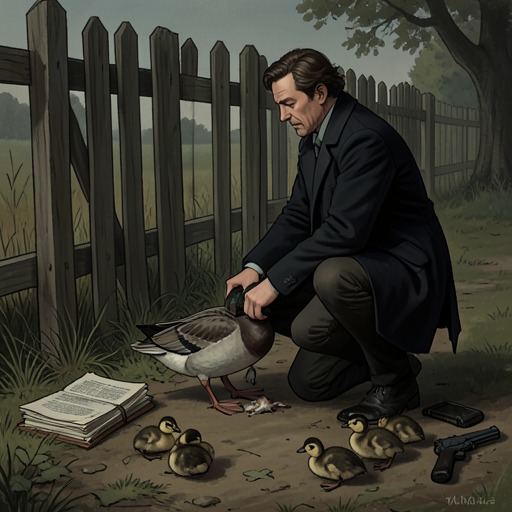
Fabiana’s first striking appearance is at Ted’s house, where she finds him carrying a two-metre diamond python he has caught with a makeshift snare fashioned from twine and a plastic broom. The snake has just soiled his arm; Ted’s smile at his successful capture disappears when he sees her. Fabiana looks from the snake to Ted and then to the house, where bright red paint has been thrown across the doorway, boarded windows, and brickwork. The scene places her arrival amid the harassment directed at him, but she does not dwell on the spectacle: her attention moves to the marked house.
Her role as a reporter is explicit when Ted invokes her work for the Herald. The professional distance between them is already complicated by the pressure surrounding his case and the danger of treating public suspicion as proof. Fabiana does not simply accept Ted’s account at this point; she returns to the subject of the accusation itself.
The Claire Bingley Question
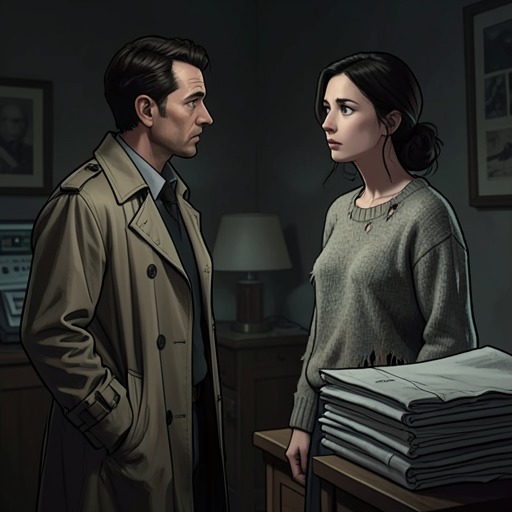
Fabiana asks Ted about Claire Bingley’s statement to police that the man who attacked her was a policeman. She points out the apparent difficulty: Claire could not have identified him as a police officer from a mugshot, and Ted would not have been in uniform during the abduction. The question puts a specific detail of Claire’s account against the circumstances of the alleged crime rather than treating the accusation as self-explanatory.
Ted resists discussing his case with her, then explains that the police interview tapes differ from the edited transcripts published in the media. In court, he had been made to watch the recordings again alongside the jury. Claire, interviewed soon after leaving hospital, was badly bruised and showed symptoms the prosecutor identified as post-traumatic stress disorder, including rolling eyes, night terrors, and difficulty eating. Her speech came in fragmented, whispered recollections, with brief references to her mother, her teacher Mrs Anderson, a white dog, and a policeman. At one point the counsellor’s question about whether Claire had said “policeman” was repeated by Claire herself; the prosecution played that clip repeatedly. These circumstances do not establish what Fabiana concludes, but they clarify why she challenges the apparent certainty of the published account and asks Ted directly about the claim.
From Interview to Investigation
Fabiana’s stance changes after she looks into the case more closely. She tells Ted she has been listening to Valerie Gratteur, who urged her to examine his arrest photographs. Valerie’s point was that Ted had no visible cuts, which she connected to a theory about defensive wounds. Fabiana admits that some aspects of the case do not make sense and says Valerie directed her to investigate Trevor Fuller. Ted identifies Fuller as the silent witness; Fabiana says she has not been able to find much about him. Her inquiry is therefore not presented as a solved case, but as a developing line of investigation prompted by a witness’s challenge and a lead that remains difficult to pursue.
The book’s broader account of the roadside encounter underscores how contested details became evidence. A passing driver and her daughter placed Ted’s car pulling off the highway at 12:47 p.m.; another pair of witnesses saw him talking with the girl two minutes later. Later testimony could not settle whether his gesture from beside the rear passenger door was a farewell or an invitation to come closer, and the dispute occupied three days in court. These details frame the evidentiary environment Fabiana enters, though the account does not say that she personally investigates each witness or resolves the disagreement.
Encounters and Narrative Role
Fabiana also sees Ted at a moment when his public composure has failed. After officers leave his home, he spends hours cleaning, then receives photographs of his infant daughter from Kelly. He is looking at the child’s first apparent tooth when Fabiana knocks. He opens the door before he can hide his wet eyes; when she asks whether he is all right, he denies his grief and claims he is using bleach. She has seen what he tried to conceal, but the encounter does not make him confide in her. Its significance is in the contrast between the case she is investigating and the private loss he is trying to keep out of view.
Fabiana’s movement from pressing Ted about Claire’s statement to acknowledging gaps in the case gives her a distinct narrative function: she tests the boundary between a media account and an investigation. Her questions are pointed, but the later attention to arrest photographs and Trevor Fuller shows that she is not confined to repeating the accusation. The evidence leaves her inquiry unfinished; what changes is that she is willing to look beyond the version of Ted’s case already in circulation.